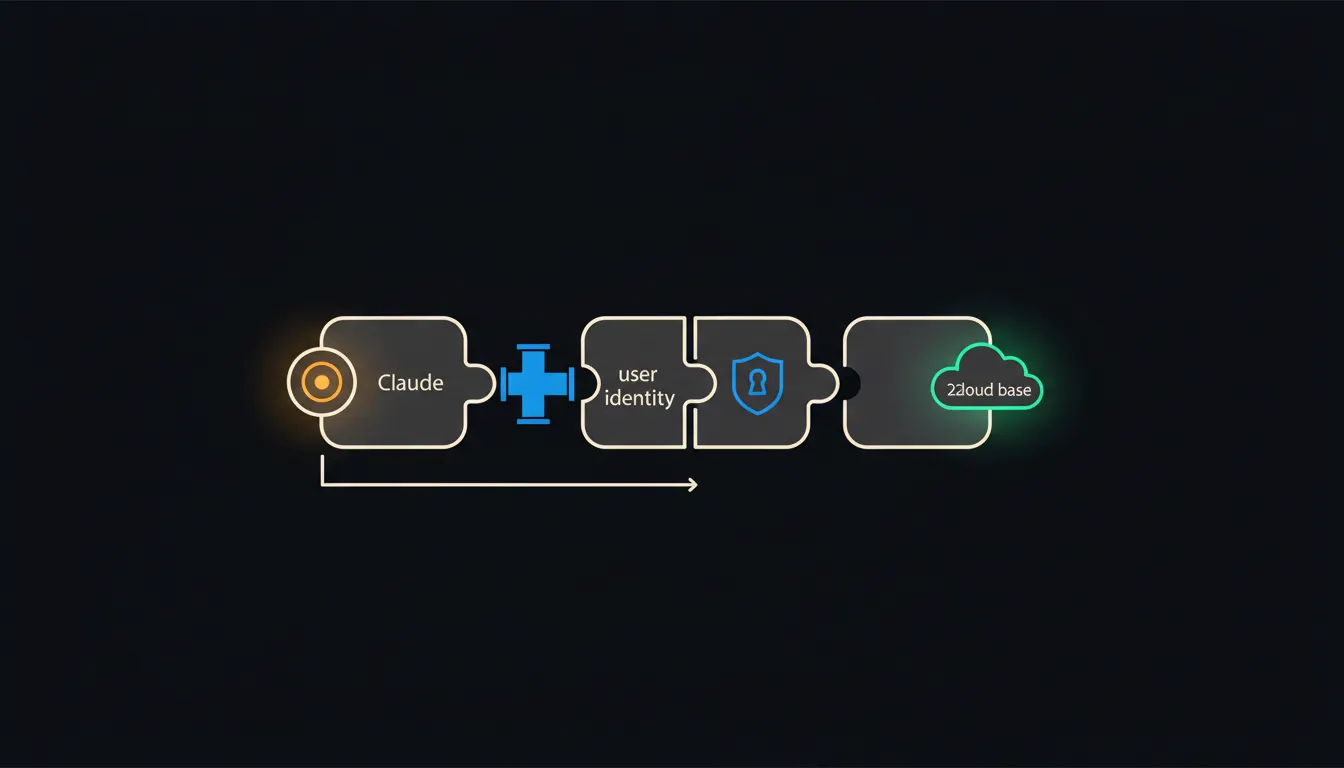
Company data and an AI system start working together once four layers fit: the model, the connection to your data, permissions, and the place it all runs. A chat window is only the first of them. Without the other three you have a clever assistant that knows nothing about your company, and every time you explain it by pasting files, data ends up where it should not be.
The work nobody wants
It starts innocently. A salesperson opens a chat, pastes in a CRM export, adds a price sheet and asks for a draft offer. The answer is good. The next day, the same again, except the sheet is a week older and the export came from a colleague who can see more customers than he can.
A month later the company has dozens of these conversations sitting in personal accounts that nobody manages. Nobody knows what lives where, who saw what, or whether the numbers in the answer matched the books. People carry data to the machine by hand, and management has no way to say whether any of it is safe.
“It works beautifully. I just don't know where it gets the numbers.”
— Leadership meeting, minutes abridged
What an AI system is, and how it differs from a chat
The EU AI Act describes an AI system, roughly, as a machine-based system that infers from its input how to produce outputs such as recommendations, content or decisions. The word that matters is system. The model sits at its core, but what it may see and where its outputs go is decided by everything around it.
For a company, that means four layers. The model: for us, Claude by Anthropic, which reads, writes and reasons. The connection: small MCP servers, bridges between Claude and the systems you already use. Permissions: every request carries the identity of the person asking. The place: all of it runs in your cloud, in one tenant, with one audit trail. Think of a new colleague. A chat window is that colleague on day one, with no badge, no keys and no desk. The other three layers are the badge, keys to the right doors only, and an office inside your own building.
Concretely: Pohoda, Raynet and the shared drive
Picture a thirty-person trading company. Accounting runs in Pohoda, sales in Raynet CRM, price lists and contracts sit on Google Drive. None of that changes. Three small bridges are added, one per system. As a rough, illustrative estimate, that is weeks of work, not a year.
- A salesperson asks how a customer is doing. Through the Raynet bridge Claude reads only that person's customers, and through the Pohoda bridge only the invoices they are allowed to see.
- A draft offer is built from the current price list on the drive, not from a sheet someone pasted in last week.
- Every read lands in one audit trail: who, when, and which system.
- When someone leaves the company, you disable one account and their access through Claude ends at the same moment.
As an illustration: a salesperson who used to assemble a brief from three windows before every call now asks one question and has the brief moments later. Along the way they saw nothing they could not have seen without Claude.
What an AI system will not do, and why that is good
It will not change data on its own. By default the bridges read and propose, and a person confirms any write into Pohoda or the CRM. It will not route around the roles you set, because it has no roles of its own. And data is not copied into someone else's database where nobody could trace it later.
Those limits are exactly why you can trust such a system with more. In its terms for commercial customers, Anthropic states that it does not use their inputs and outputs to train models by default. The rest of the control stays with you: it runs on your infrastructure, the permissions are yours, and so is the record of every access.
What it would take
Less than people expect. You start with one system, usually the one people copy from most today. We build an MCP server for it, connect it to your sign-in, deploy it in your cloud and open it to a small group. If it holds, the next bridge follows. Routines that repeat, such as how your weekly sales review should look, go into a skills library, and the next morning anyone can use them with their own permissions.
What's left
The model is not what holds a company back today. Claude can read contracts, write offers and do the arithmetic. What holds it back is the gap between Claude and the data you already have, and whether you can bridge it while keeping a clear view of who sees what. A chat is one layer. A system is all four.
If you want to see what the four layers would look like in your company, write to us. A short call, we go through your systems and tell you where we would start.