Every small company knows the pattern. A new person starts on Monday. Tuesday they ask how a quote gets issued. Wednesday they want to know who approves discounts. Thursday they're searching for the contract template. The whole time, someone who would rather be doing their own work is being pulled away. It is not that the company has bad processes. It is that those processes do not exist as living documents. They live in people's heads, in a PDF from 2021, or in a chat thread the new person does not have access to yet.
The work nobody wants to do, but everyone ends up doing
Onboarding in a small company usually looks like this: the owner or team lead sets aside a day or two, walks the new person through the key things, hands over a binder or a link to a shared folder and says "ask whenever you need." Well-intentioned. But the new person asks every day, and someone has to answer.
Most of those questions in the first few weeks are questions about facts, not judgment calls. What is our standard payment term? Who is the contact for logistics? Where is the customer email template? This is information the company already has. It is somewhere. Nobody has connected it to the person who needs it right now.
For three weeks I was afraid to ask about things that should probably have been obvious. I searched in chat, in folders, in old emails. Sometimes I just guessed.
— Starting a new role: a situation most people recognise
What it actually means to have knowledge genuinely available
A company knowledge base (a wiki, a shared folder, a Notion page) is a good idea. The problem is that information gets stale. Someone updates the terms, nobody updates the page. The new price list came into effect in March, but the January PDF is still the first result in the Drive search. And even if the documentation were perfect: the new person still has to navigate it, search with the right words, and know which documents are current.
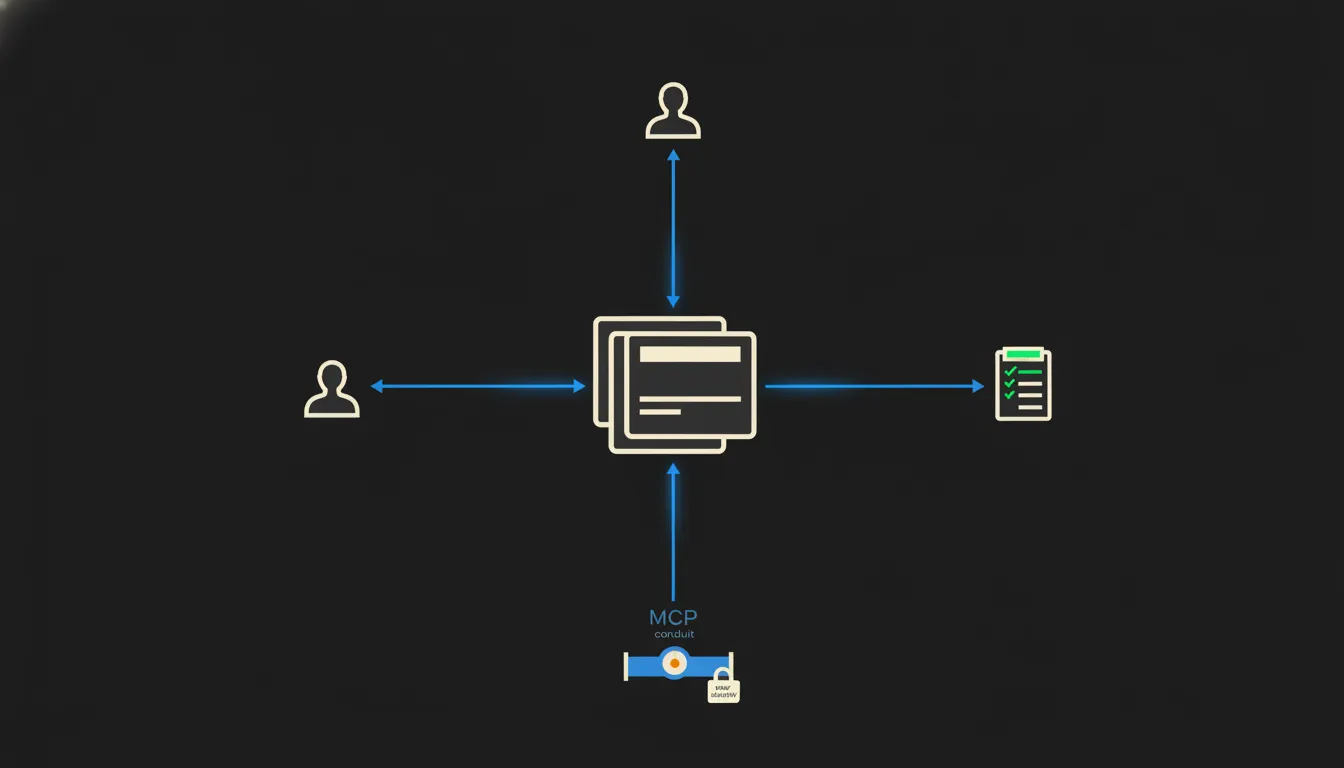
AI stack connects Claude to the company skills library through an MCP server. That server knows what the new colleague is allowed to see, and Claude only shows them that. The new colleague asks in plain language: "How do we handle discount approvals?" Claude answers based on the document the team approved. Not the 2021 version, not a guess: the version marked as current today.
Concretely: your Notion or SharePoint as a living library
The team has procedures in Notion or SharePoint. That stays. An MCP server is added, connecting to those documents, knowing which version is current and who can read what. The new colleague gets a login identity and access to Claude. From day one they can ask questions, and they get answers built on what the team approved just yesterday. The team does not have to pick up the phone or respond to chat. An illustrative estimate: a company with five new hires a year saves dozens of hours of senior colleagues being interrupted as an informal helpdesk.
- The new colleague writes a question in plain language. Claude finds the answer in the current documents.
- When the team updates a procedure, Claude answers based on the new version immediately, no manual sync needed.
- Claude includes a link to the source document so the new colleague can verify it themselves.
- If an answer does not exist or depends on a manager's judgment, Claude says so clearly, no guessing.
- The team can add new skills to the library at any time, and they are available the next morning.
An example: a small Czech trading company brings in a new sales rep. In the first week they do not interrupt a colleague or open a stale product presentation. They type into Claude: "What is our process for handling a warranty claim from an international customer?" and get a step-by-step answer built on the process the sales director approved last month. The colleague gets on with other work.
What the skills library will not do and why that is good
Claude answers based on what the company has documented and approved. It does not approve exceptions, evaluate performance, or allocate responsibility. If the new colleague needs to decide on a non-standard situation (a customer asking for a discount above the limit, a supplier requesting unusual payment terms), Claude can explain the procedure and flag the rule, but the decision stays with the manager.
That is not a limitation. It is the design. The company gets an assistant that always answers according to current rules and never exceeds its mandate. The manager does not need to audit what Claude said. They know Claude could only say what the company put into the library and approved. The boundaries are legible and fixed.
What it would take
We do not build a new wiki. We do not rewrite your processes. We connect what the company already has (Notion, SharePoint, Google Drive, or a shared folder) to Claude through an MCP server. The server runs on your infrastructure, carries each user's identity, and nothing is sent to any vendor's shared cache. The company gets one governed platform, one permissions overview, one log of who asked what and what answer they received.
What remains
The model is not the bottleneck. The bottleneck is the gap between what the company knows and what a new colleague has available at the moment they need it. The skills library closes that gap, not by replacing people, but by making sure knowledge is no longer trapped in heads or outdated files.
Write to us. A short call is enough. We will look at what your company has documented and show you how to turn it into a living library that a new colleague can draw on from day one.