When companies hear about AI in accounting, the first question is almost always: what happens when it gets something wrong? It is about money, correctness, taxes. The caution is justified. But the problem is rarely the model. The problem is that nobody has said where AI should start and where it should stop.
The work nobody wants to do
Every month a company receives a pile of documents. Supplier invoices, bank statements, petty cash receipts, a lunch receipt from last week. Someone has to open each one, read it, and file it in the right category. Match it to the right project. Check whether the invoice number corresponds to an order.
It is work that demands attention but not creativity. It repeats every month in the same rhythm. Either the owner does it on a Sunday evening, or an accountant does it at an hourly rate that would be better spent elsewhere.
Twenty invoices arrived. I spent an hour opening each one, reading it, deciding which category it belonged to, and entering it into the system. An hour of work I will repeat in exactly the same way next month.
— Owner of a small manufacturing company, 8 employees
What AI in accounting actually means
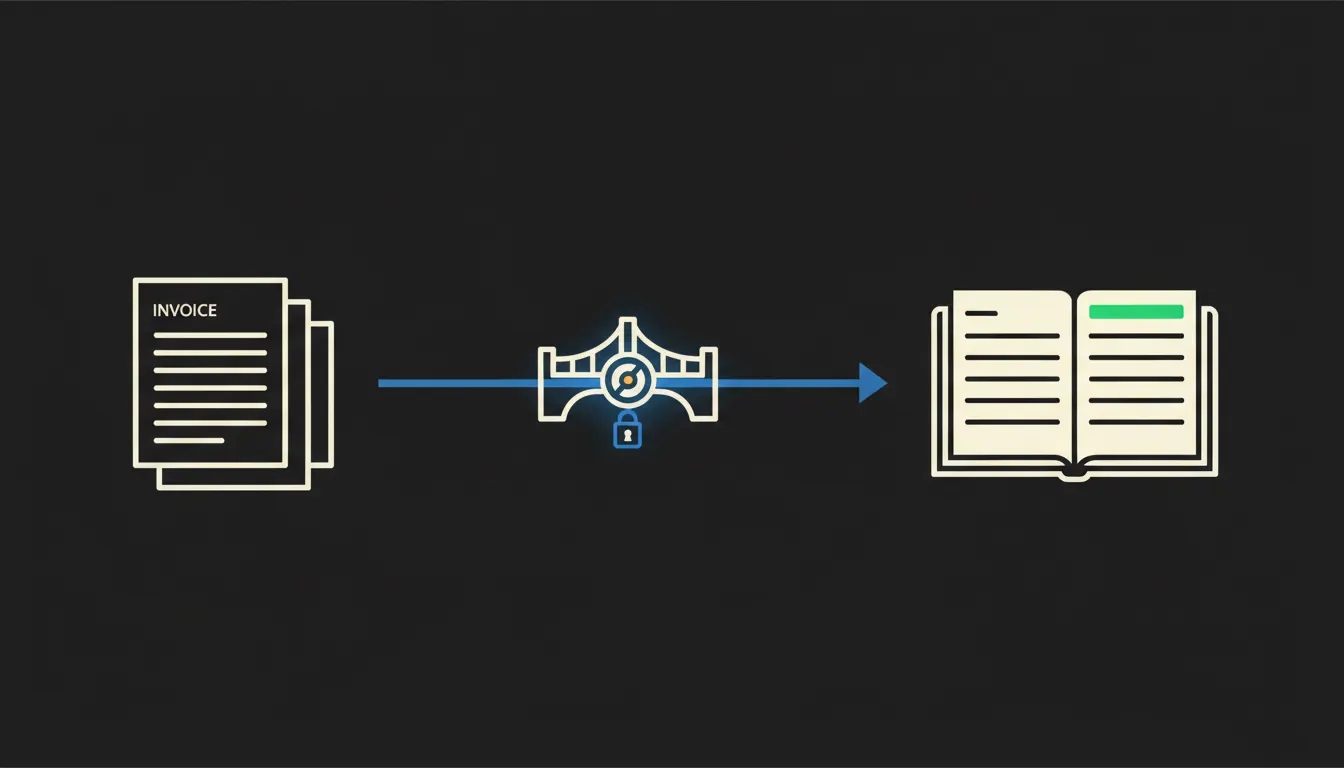
AI in accounting does not mean Claude gets administrator access to your system and does whatever it likes. It means Claude receives exactly the data the accountant who is running it can see. Through an MCP server that carries the identity and permissions of that specific user. Claude sees what she sees. Nothing more.
The MCP server is a small, focused bridge. It does not hold the master password to the accounting system. It has access to the documents and category codes that a specific user has unlocked for it. It reads the invoice, checks the history of similar documents, proposes a category. Then it stops. It waits for confirmation.
In practice: Pohoda and Fakturoid
Pohoda from Stormware serves more than 130,000 companies in the Czech Republic and Slovakia. Fakturoid is a popular cloud platform for smaller businesses and freelancers. Both have export interfaces or APIs. An MCP server connects to that interface and reads documents with the logged-in user's identity. Your system stays where it is. Only the bridge is added.
- Claude reads a new supplier invoice and proposes a category based on how you have categorised similar invoices before.
- It flags when an invoice number does not match any purchase order in the system.
- It prepares a list of unmatched payments from the bank statement for the past 30 days.
- It drafts the posting description based on the document annotation and your chart of accounts.
- It checks whether an invoice from a regular supplier is higher than usual and flags the discrepancy.
Consider an accountant who processes documents for five smaller clients. Each month she spends an average of two hours per client on categorisation. With Claude as an assistant, in a typical scenario she would be reviewing proposed categories and confirming them rather than entering each document from scratch. Time spent on routine decreases; time spent on review and exceptions increases.
What AI in accounting does not do, and why that is a good thing
Claude in this setup does not sign tax returns. It does not send payments. It does not decide whether an expense is tax-deductible under local law. These steps require judgement, accountability, and local knowledge that belongs to the accountant or a tax adviser.
The boundary is not there because the model is not smart enough. It is there because accounting correctness has a specific person accountable for it. Claude assists that person; it does not replace them. Companies that understand this start with AI quickly and without taking on unnecessary risk.
What it would take
This is not a year-long project. An MCP server for Pohoda or Fakturoid is a focused piece of infrastructure: it connects to the system's export interface, carries user identity, reads documents, returns proposals. It runs on your infrastructure, not ours. No documents leave your perimeter.
Where the real gap is
The model is not the bottleneck. Claude can recognise a category. The gap is between Claude and the documents sitting in your system. That gap today means someone has to act as an intermediary, copying data by hand from one place to another. An MCP server closes that gap and moves the intermediary to where their judgement is actually needed: approval, exceptions, decisions that require context.
If you want to know what a connection like this would look like for your company and your system, write to us. A short call is enough to find out where the gap is in your case and whether closing it makes sense.