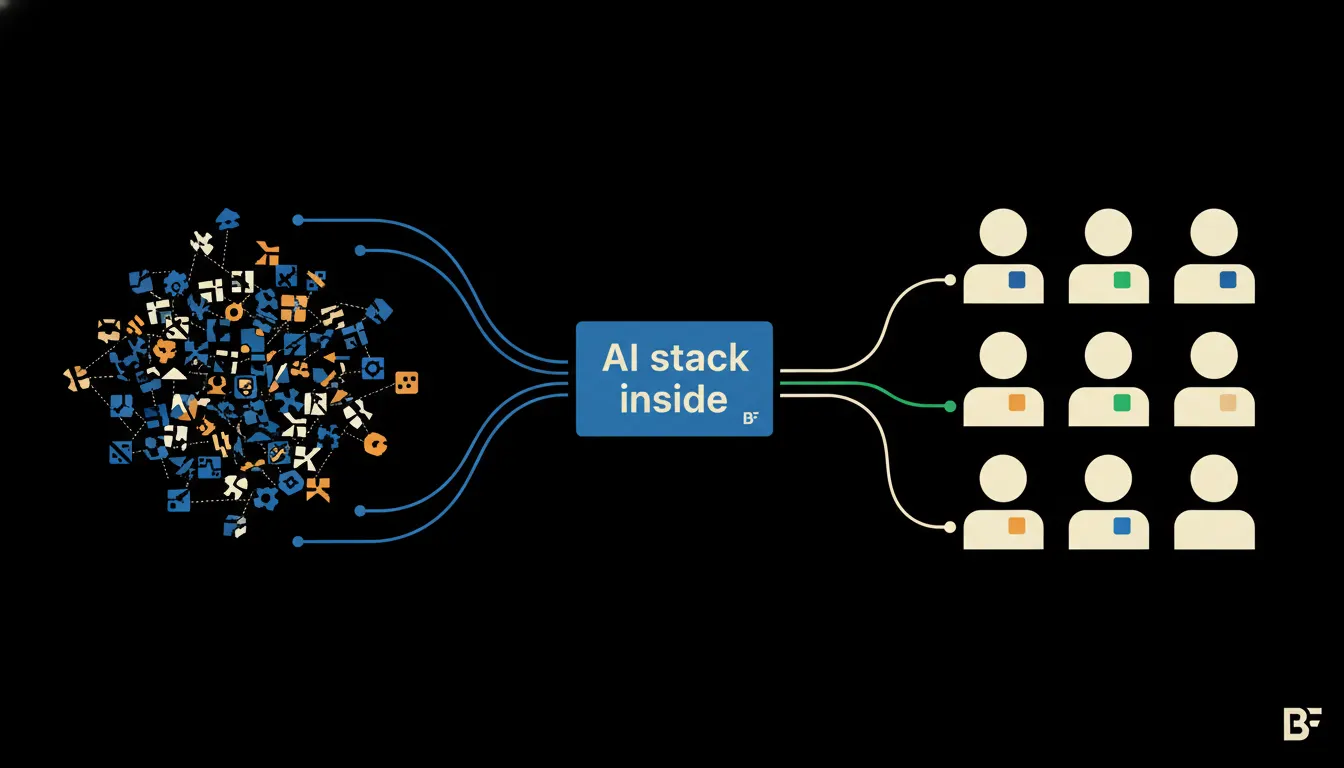
At Business Factory, every team had quietly subscribed to a different AI tool. Sales had ChatGPT. Marketing had Claude. A few engineers had both, plus Perplexity. They were all useful, and not one of them could see the company's own data. That is the problem we set out to fix.
One company, five AI subscriptions, zero shared brain
Before we started, the picture looked familiar to anyone who has worked in a modern company: paid AI accounts scattered across personal credit cards, every team typing the same context into a different chat window, and a constant low-level worry about which conversation might be leaking which client name into which vendor's training pipeline.
Worse, none of these tools could actually answer the questions that mattered to the business. "What did this client buy last quarter?" "Which ad creative is underperforming this week?" "Where is the contract for that renewal?" Every good answer lived somewhere in Google Drive, in HubSpot, or in the Google Ads dashboard, and the AI had no way to reach any of them.
Give everyone the same brain, with the same access controls they already have today.
— The brief, in one sentence
Step one: one provider, one tenant
The first decision was the easy one. We consolidated everything onto a single Claude Team workspace under Business Factory's own tenant: one bill, one admin, one audit trail. The personal subscriptions went away. Conversations and uploaded files now live inside Business Factory, not inside someone's personal account at a vendor.
Just doing that (without any custom infrastructure yet) already cleaned up a lot. People stopped pasting contracts into random tools. Spend became visible. The legal team finally stopped wincing every time we opened our laptops.
The hard part: respecting Google permissions
Business Factory runs on Google Workspace. Documents, spreadsheets, decks, emails, calendars: almost every piece of company knowledge lives in Drive and gets shared through Google's permission system. That system is the source of truth for who can see what, and it took years to get right.
Most "connect your AI to your Drive" tools throw that work away. They authenticate once as a service account, index everything, and then trust their own access logic to keep secrets safe. We were not willing to do that here.
So we built the connectors ourselves, as MCP servers that authenticate to Google as the user, using their own Google credentials, the same way the Drive web app does. When someone asks Claude a question that needs to touch Drive, the call is made on their behalf, with their permissions, against the same APIs that the rest of Google Workspace uses. If they would not have seen the file in Drive, they do not see it in Claude either.
Then the fun started: real skills, not toys
Once the auth layer was solid, we could build skills that actually do work, not just retrieve text. The first wave covered the things people were doing manually every day:
- A HubSpot skill that pulls the right account, latest deal stage, and recent contact notes, without leaving the Claude chat.
- A Drive skill that can find, summarise, and compare documents the user is already allowed to read.
- A research skill that scrapes a prospect's website and recent news, then drops the findings into a structured account brief.
- An ads skill that watches Google Ads campaigns and flags creatives whose performance is slipping, with suggestions for what to test next.
Each of these is built as a small, focused MCP server. Each one carries the user identity through to whatever it talks to. None of them assume: every action goes through the same checks the underlying system would do for that user anyway.
The skills library: the part we are most excited about
The next step, the one Business Factory is rolling out now, is letting teams publish their own skills. The performance marketing team has a way they like to evaluate ads. The customer success team has a particular shape they like their renewal briefs to take. The founders have a weekly format they use to review the business.
Instead of all of that knowledge living in someone's head or on a wiki nobody reads, it now lives as a skill in a plugin everyone can call. Publish once, version it, improve it. Anybody in the company can use it, with their own permissions, the next morning.
The same person, with the same access, can now do the work of three, because the boring parts of the job are routed through a brain that finally knows the company.
— What changed for Business Factory
Where this is going next
We are not done. The Google Ads optimisation MCP is becoming smarter every week: it now constantly watches active campaigns, scores creative against recent winners, and proposes specific changes rather than just charts. The next big chunk of work is making the skills library easy enough that non-technical teams can publish to it themselves, without needing an engineer to wire each one in.
The pattern, though, is the same one we keep seeing at every company we work with: the moment AI sits on top of the data and respects the access rules you already have, it stops being a novelty and starts being a teammate. That is the part we built for Business Factory. That is the part we want to build for everyone else.