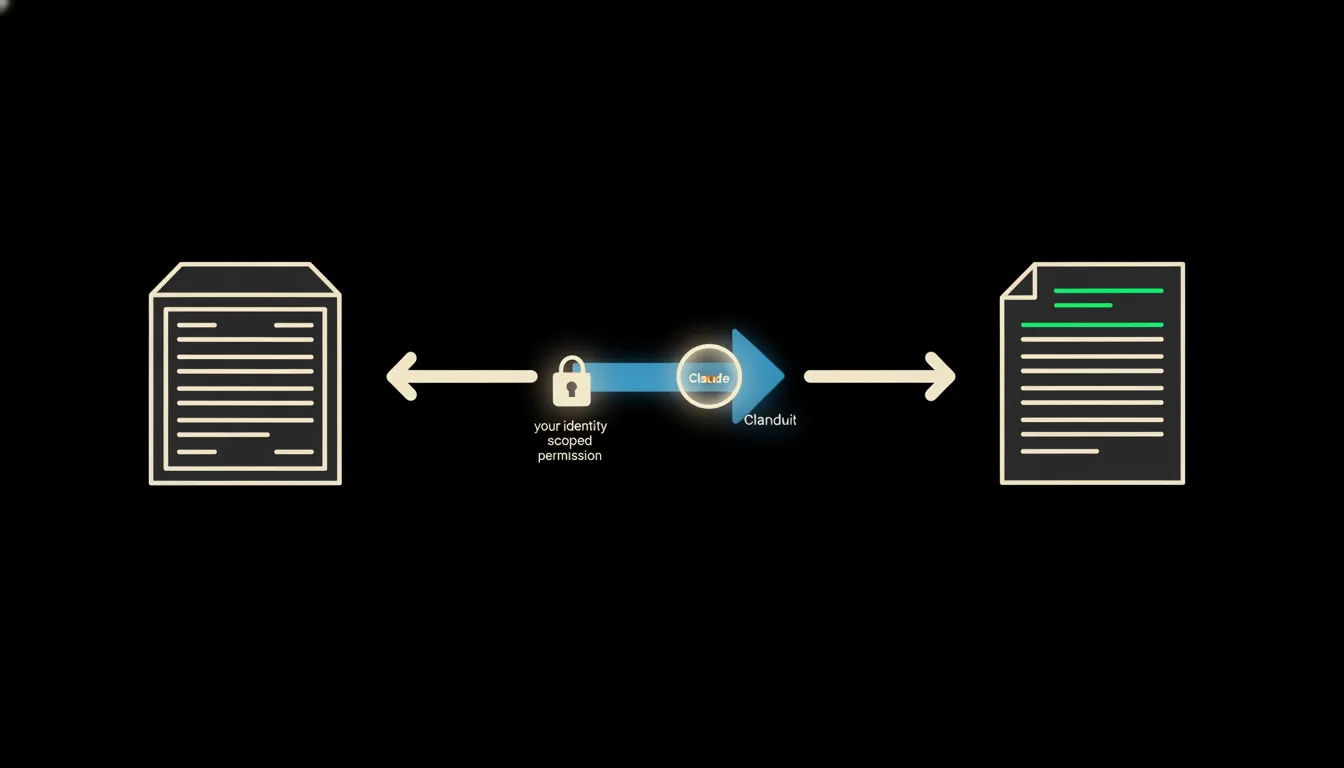
Every company sits on mountains of data — invoices, customers, orders, emails. Claude is a capable assistant. And yet you spend your days copying information from one window into another, as if it were 2003. The problem is not how Claude thinks. The problem is that it cannot reach your data. An MCP server is the bridge that closes this gap.
The work nobody wants to do
It goes like this: you need to check whether a customer has paid their invoices and whether their service contract is still valid. You open the accounting system, search for the customer, copy the status into your Claude chat. Then you open the CRM, search for the same customer, read the contract, copy the key terms. Only then do you ask Claude what to write. Ten minutes for one question. Twenty times a day.
Nobody measures that time. It never appears in a report. But everyone feels it — a quiet fatigue that builds every day and never quite goes away. That is exactly what an MCP server solves. Not by doing the work for you — but by removing the copying that was slowing the work down.
A month spent copying data from one window to another — and nobody even sees it in the report.
— A typical accounting desk at a small company, every month
What an MCP server actually is — without the jargon
MCP stands for Model Context Protocol. Think of the word "protocol" as traffic rules: the protocol tells cars (AI) how to drive on the road (to your data) — where they can turn, where traffic lights stop them, who has right of way. Without rules, everyone drives as they please and accidents become routine. With rules, traffic flows safely and predictably.
An MCP server is a specific program — small, focused — that sits between Claude and one data source. One MCP server for your accounting system. Another for your CRM. A third for Google Drive. Each server knows exactly what it may show Claude and what it may not. The key detail: it may only show what the signed-in user already has permission to see. Claude will never see another department's data, another customer's records, another person's files.
Concretely: accounting and CRM as data sources
Accounting systems like Pohoda or invoicing tools like Fakturoid are the backbone of thousands of small Czech companies. Both have well-documented interfaces — which makes them natural data sources for an MCP server. Neither system changes: it stays exactly where it is, in exactly the format you are used to. The MCP server is added alongside it — a quiet intermediary that hands Claude what it needs, on request.
- Claude asks the MCP server: "What is the status of invoice 2024-1187 for customer Novák?" The server verifies your identity, retrieves the data from the accounting system, and returns the answer.
- Claude receives the context and drafts a payment reminder in exactly the tone you showed it once as a template.
- When the customer pays, the MCP server can notify Claude — and Claude updates your CRM without you switching windows.
- The entire exchange is recorded in an audit log: who asked, what they asked, when, and what Claude replied.
Picture an accounts-receivable clerk at a small company who currently spends two days every month sending payment reminders. With an MCP server connected to the accounting system, Claude receives the list of outstanding invoices, drafts the reminder texts, and prepares the send queue — she reviews, approves, and sends. Two days becomes two hours. No magic — just the copying removed.
What an MCP server will not do — and why that is a good thing
An MCP server is not an automation that signs contracts or approves expenses on your behalf. Deliberately. Access to data and the right to act on it are two different things — and MCP architecture keeps them separate by design. Claude can read a contract, flag unfavourable terms, suggest alternative wording. It cannot sign. It should not.
This boundary is not a technical limitation. It is intentional design. Companies that deploy AI without clear boundaries quickly find they no longer know who decided what and why. An MCP server never raises that question — because responsibility for the final action stays clearly with a person throughout. Exactly where it belongs.
What this would mean in practice
An MCP server is not a year-long project. It is one well-scoped piece of software that runs on your infrastructure — not on a vendor's servers, not in someone else's cloud. Your data never leaves the environment you control. The audit trail is entirely yours. And if you ever decide to turn the server off or change it, the cut is clean — no data is locked away elsewhere.
The model is not the bottleneck — the gap is
Claude is a capable assistant. But without access to your data, it is like a new colleague who started today and knows nothing about the company — smart, but blind. An MCP server gives it context: customers, invoices, orders, contracts. And it gives exactly as much context as the person asking is allowed to see. No more. No less.
If you are curious what an MCP server would look like for your systems, write to us. A short call is enough to work out what would make sense — and what would not.