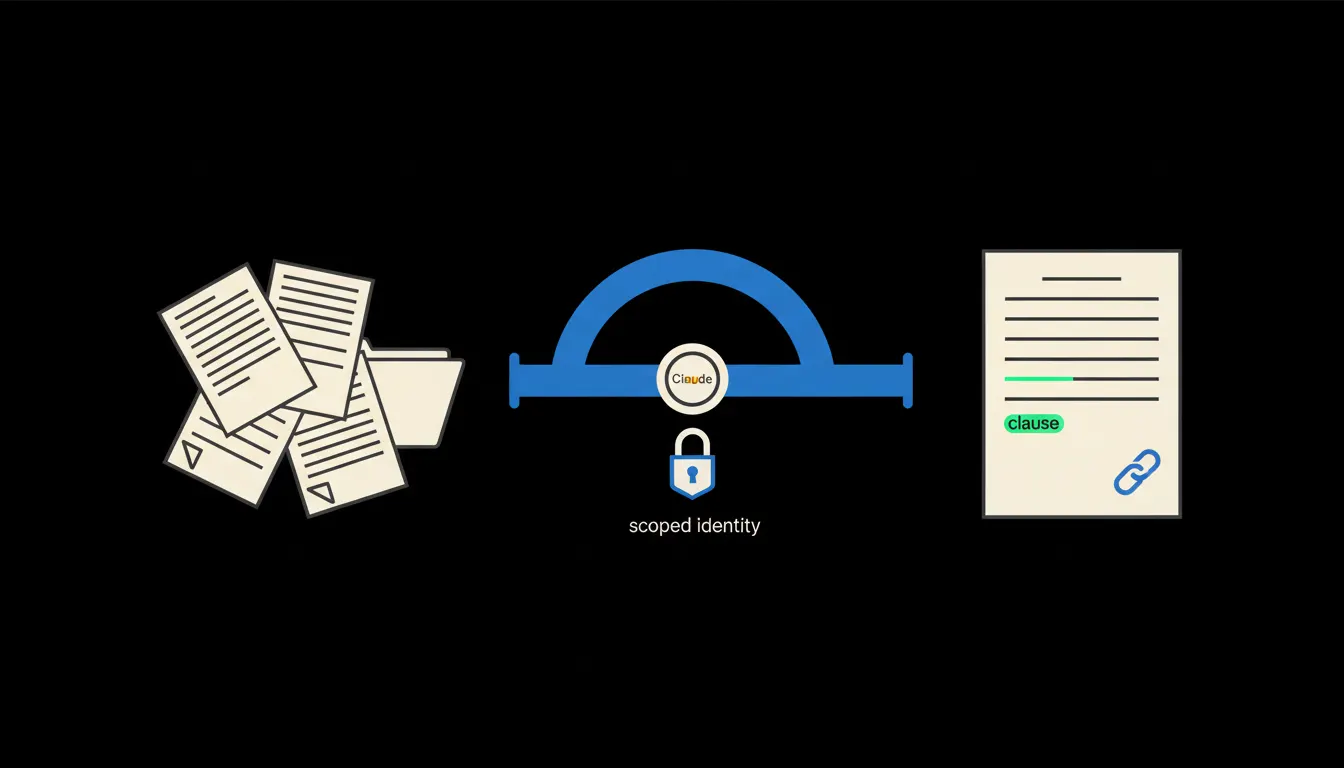
How do you find a contract in a company archive when you cannot remember the file name? Most companies solve it by asking whoever has been there longest. The contracts are on a shared drive, in mailboxes, in a folder left by someone who quit three years ago, and part of the history is scanned paper. The answer is in there. It just cannot be reached in under half an hour.
The work nobody wants
The question is usually mundane. Did we agree a three month notice period with this supplier, or six? Is there an indexation clause in that lease? When does the discount we promised last year actually start? Nobody needs a legal opinion. They need one sentence from one paragraph.
So the search begins. Full text search on the shared drive returns forty hits, because the word contract appears in every other document. You open eight PDFs. Three are scans with no text layer, so search quietly finds nothing inside them. Two are versions and there is no way to tell which one was signed. Forty minutes later you call a colleague and ask whether she remembers. She does. Roughly.
I am sure we had it in there. I just do not know which version.
— A Thursday spent looking for an amendment, abridged
What a connected archive actually means
The archive is not disorganised. The interface is. Google Drive can filter by file type, owner, date and words contained in a document. It is a filter language, and it assumes you roughly know what you are after and where it sits. It has no way of knowing which of two versions was the one that got signed.
A connected archive means you ask in a sentence instead of building a filter. Claude reaches the systems where the contracts already live through a small MCP bridge. Nothing is migrated, nothing is copied into somebody else"s database. The bridge carries your identity, so Claude reads exactly the folders you can already open, and the answer comes back with a quoted paragraph and a link to the file.
Concretely: Google Drive, the mailbox, and the folder left behind
In a twenty-person company the contract history usually sits in three or four places: a shared drive in Google Workspace or Microsoft 365, the sales team"s mailboxes, sometimes a DMS, and scans of signed originals. Companies that supply the Czech public sector have another slice published in the state contract register under act 340/2015. The bridge is added to what you already run. None of it gets switched off or replaced.
- Finds a document by what is in it, not by its name. You ask about the notice period, not about contract_final_v3.pdf.
- Tells versions and amendments apart. It says which version was signed last and what changed it.
- Pulls the specific clause and quotes the paragraph it came from.
- Attaches a link to the source so you open the document and read it yourself.
- Reaches what sits outside the drive too, such as an attachment buried in an old mail thread.
Say a twenty-person made-to-order manufacturer has contracts with fifty suppliers and eighty customers, plus ten years of amendments. The operations director asks in the morning which supplier contracts have price fixing that expires this quarter. The answer arrives as five contracts with quoted paragraphs and links. She opens three of them and decides which suppliers need a call. The example is illustrative, but the type of question is entirely ordinary.
What contract search will not do, and why that is good
It does not give a legal opinion. It does not judge whether a penalty is proportionate or whether the clause is worth renegotiating. It changes nothing in the archive, signs nothing and sends nothing. It reads, compares and shows you where the text sits.
That boundary is exactly why the pattern is trustworthy. Every answer carries a link, so you verify it in ten seconds. An assistant that answered confidently without a source would be worse than a colleague"s memory, because a colleague at least admits when she is unsure.
What it would take
One small MCP server against the system where the contracts sit, running on your cloud and in your tenant, with one audit trail of who asked what. You start with a single folder and a single kind of question, not with a migration of the whole archive. It is weeks rather than a year-long project, and once the first bridge stands, the second system is mostly a matter of connecting it.
What is left
Claude reads a Czech contract and its amendments without trouble. The model is not the bottleneck. The bottleneck is the distance between the model and a folder named six years ago by someone who no longer works here. That gap is the part we close.
If you have an archive where everything can be found, just never quickly, write to us. A short call is enough to map where the contracts sit and what the first bridge would need to do.