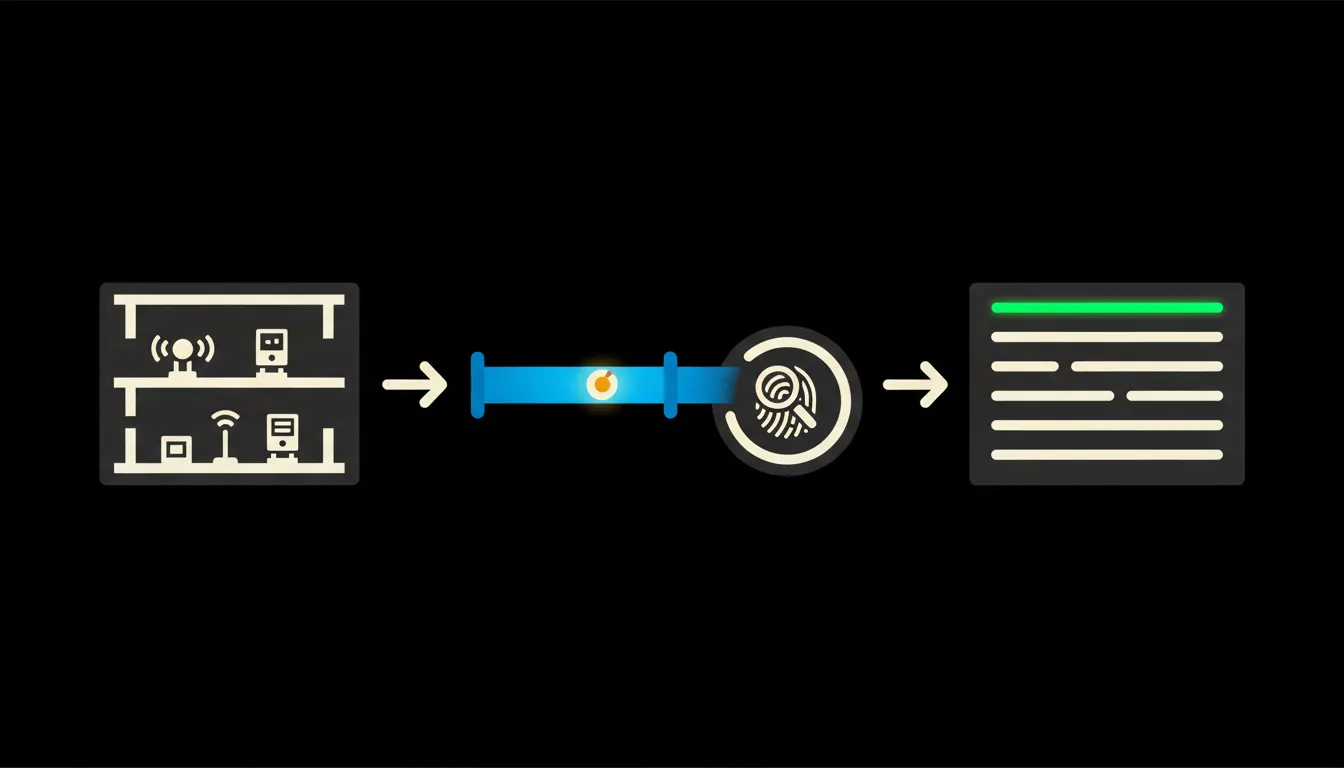
People searching for an MCP server for Home Assistant are rarely interested in the protocol. They are interested in the fact that a building has spent a year collecting data from sensors, meters and thermostats, and nobody can get a simple answer out of it. MCP is the socket through which Claude asks your Home Assistant, and answers in a sentence instead of a chart.
The work nobody wants
A smart building holds more data than anyone reads. Temperature per room by the minute, consumption per circuit, door and window states, pump run times, solar production. The trouble starts the moment somebody wants an answer. What did the air conditioning on the second floor cost us last August? Did we heat empty offices over the holidays?
Then comes the part nobody wants. Open three dashboards, export a CSV, glue it to the utility invoice in a spreadsheet, and discover that one circuit is missing a month of history. It takes half a day and produces one chart that nobody opens at the next meeting anyway.
We have the data. Nobody can ask it a question fast enough for the answer to still matter.
— An operations meeting, abridged
What connecting through MCP actually means
MCP (Model Context Protocol) is an open standard published by Anthropic in November 2024. It describes exactly one thing: how a model can ask another system for data, and how that system answers. Instead of a separate integration per tool, you get one socket. Home Assistant added its own MCP Server integration in release 2025.2, in February 2025, so it can expose the entities you explicitly allow.
That is a starting point, not a finished operational tool. A company bridge adds four things: it runs on your own infrastructure next to Home Assistant, it carries the identity of the person asking, it can reach into history and aggregate it, and it copies your data nowhere. Claude asks the bridge. The bridge asks Home Assistant. The answer comes back the same way and leaves a record behind it.
Concretely: a building that has run Home Assistant for two years
Say an office building with sixty entities: sub-metering per floor, thermostats, window contacts, heat recovery, a water meter, solar. None of it changes and none of it moves anywhere else. One small server appears next to Home Assistant, and a handful of questions can suddenly be asked in a sentence:
- How much the third-floor air conditioning drew in August, and how that compares with last year.
- Which offices were heated over the weekend while the motion sensor reported nothing.
- How long a window in the server room stayed open in January, and how many times.
- Whether heat recovery faults always follow a power cut, or arrive at random.
- How much of the solar production the building actually used, and how much went to the grid.
The second half is the more interesting one. The utility invoice sits in your accounting system, in Pohoda for example. When the bridge can see both, you can ask why the sub-meter reading disagrees with the figure on the invoice. Today that question mostly goes unasked, because the answer costs a day of work. This is an illustrative example rather than a measured case, but it is exactly the kind of question that starts showing up every month once the bridge exists.
What Claude will not do with your building, and why that is good
It will not switch the heating. It will not open a door. It will not start a pump. Read is the default state of the bridge, even though Home Assistant has everything needed to control devices. When you do want an action, the bridge gets it as a named operation with its own approval: who may run it, on which entities, at what time, signed into the log.
It looks like a restriction. It is the condition under which a bridge like this can be deployed at all. The responsibility for pipes not freezing in the warehouse sits with the facility manager, and it does not get handed to a system that might helpfully shift a heating curve. Claude describes what happened and suggests what to do. A person puts a hand on the switch.
What it would take
Less than it sounds. Home Assistant is already running. We need the list of entities allowed out and the roles of the people who will ask. The bridge runs at your place, next to Home Assistant or in your cloud, nowhere else. The first version covers the two or three questions that bother you most, and only once the answers hold up do more get added. This is not a year-long project. It is one small server and an afternoon of deciding who may see what.
What's left
The model is not the bottleneck. Claude can read a year of building history and find the weekend when an empty floor was heated. It simply cannot reach that history. Between the model and your data there is a gap, and the gap is the whole problem.
Closing it is what we do. We build a small MCP server over what you already run, make it carry the identity of the people asking, and host it on your infrastructure. Write to us. A short call is enough to say whether your building can be connected in two weeks or in six.