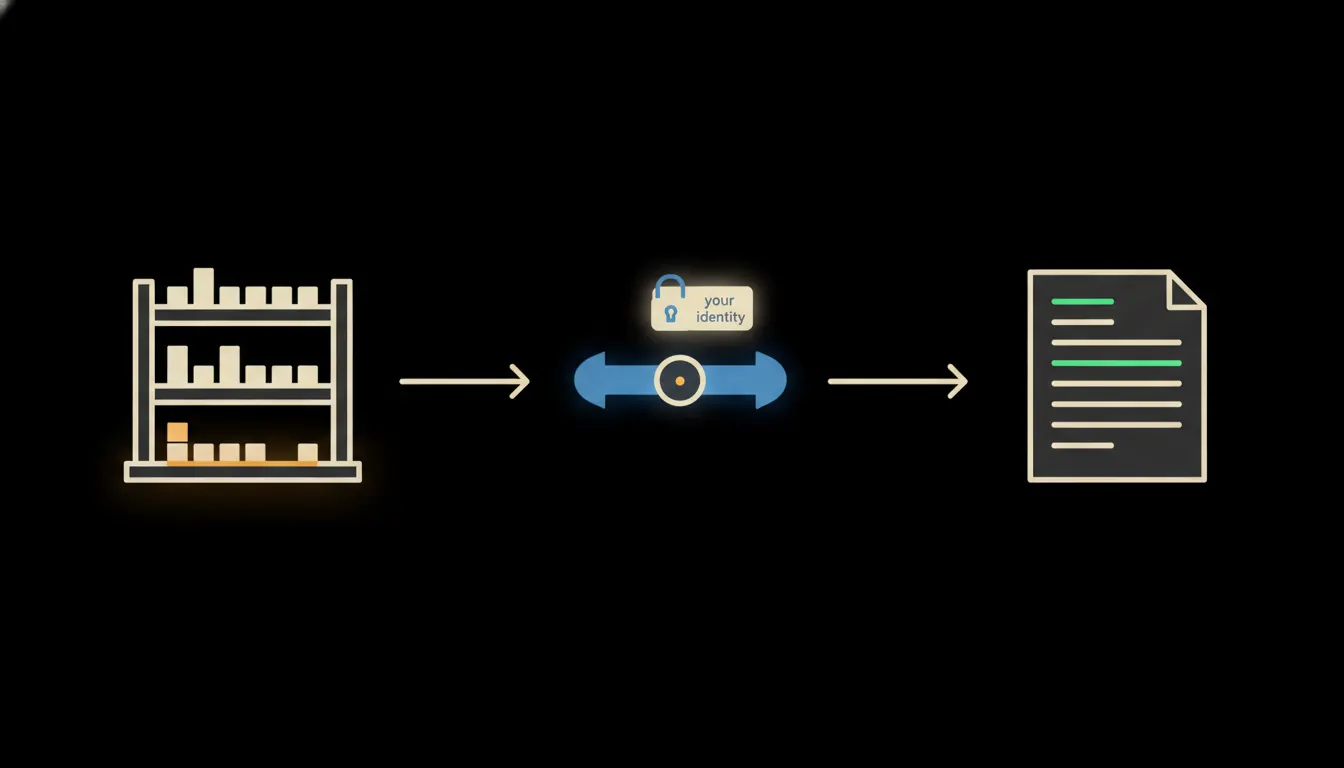
Monday morning. The warehouse manager opens the inventory system, exports stock levels to a spreadsheet, compares them against minimum thresholds they keep in their head or a separate file, and starts writing emails to three suppliers. Ninety minutes, exactly the same as last week and the week before. The data was sitting in the system the entire time. It just had nobody watching it.
The work nobody wants
Manual inventory management has a specific rhythm: export, copy, compare, email. Each step is simple. Together they add up to four steps that repeat every week, cost someone an hour or more, and can fail quietly: a missed item, a copied number with a typo, an email sent a day late.
The problem is not complexity. The problem is the gap: the data lives in the system, but nobody (and no tool) is actively comparing it against what needs ordering. Not until someone does it by hand.
Export on Monday, email on Tuesday, confirmation on Wednesday, and only then do we know what arrives next week.
— A typical weekly procurement cycle, condensed
What connected actually means
AI stack builds a small MCP server that connects to the system where the company already tracks inventory, most often Pohoda, Money S3, or Shoptet. The server reads live stock levels and passes them to Claude. Claude evaluates them against pre-set minimums and, when a threshold is crossed, drafts a reorder proposal: specific items, quantities, supplier.
The MCP server accesses data under the identity of the person who triggered it. Their login permissions in Pohoda define exactly what Claude sees. Nothing more, nothing else. No copy of the data on an external server.
Concretely: Pohoda and a Shoptet e-shop
A company runs its e-shop on Shoptet and tracks inventory in Pohoda. The MCP server reads stock records directly from Pohoda, no export, no spreadsheet. Whenever any item drops below its minimum, Claude drafts a reorder proposal: it lists the items, pulls supplier numbers from Pohoda, and estimates quantities based on average consumption over the last 30 days. The buyer receives a ready-made draft, one click from sending.
- Reading live stock levels from Pohoda on a set schedule or on demand
- Comparing against minimum thresholds set by the buyer or warehouse manager
- Drafting a reorder proposal with items, quantities, and supplier references
- Routing the draft for approval: by email, internal chat, or directly in Pohoda
- Logging the confirmed order back into the system once a person approves it
Illustratively: a small company with 200 stock-keeping units and a weekly order cycle can compress roughly two hours of manual work down to fifteen minutes of review and confirmation. The saved time flows back into work that actually requires judgment.
What AI inventory management will not do and why that is good
Claude does not choose suppliers, negotiate prices, or set inventory strategy. It does not know that the company wants to favour a supplier currently in renegotiation, or that last week a shipment from one vendor arrived damaged. That business memory and context stays with a person.
And that is exactly why the system can be trusted. Claude handles the routine: it compares numbers and drafts proposals. A person handles the decisions: confirms, adjusts, or rejects. A clear boundary is not a weakness in the system; it is the condition under which the system works reliably over time.
What it would take
Building an MCP server for Pohoda or Money S3 is a matter of days, not months. The server runs on your infrastructure, your server or your cloud. No data leaves your environment, neither to us nor to any other provider. The audit trail shows who approved what and when.
Minimum thresholds and supplier references are configurable without coding, directly in the interface. If the product range or seasonal demand shifts, the limits are updated. The bridge adapts.
What's left
The model is not the bottleneck. Claude handles orders, quantities, and suppliers very well. The bottleneck is the gap between Claude and the data already sitting in Pohoda or Shoptet. That gap is what causes someone to run a manual export every Monday morning and write supplier emails from scratch. We close that gap.
Write to us. A short call is enough to find out where your inventory data lives and how quickly a bridge can be built.