Connecting Pohoda to an e-shop is something almost every Czech online retailer talks about. In practice, only those who paid for custom development years ago actually have it. Everyone else copies orders by hand every day.
The work nobody volunteers for
A customer places an order. An operator opens the e-shop admin, manually re-enters it into Pohoda, creates an invoice, checks stock, decrements the items and updates the shipment status. Four to six steps per order, repeated continuously.
An e-shop with thirty orders a day can spend over an hour on this copying alone. Nothing complex, nothing requiring judgement. Pure routine that still costs time and occasionally produces errors: an oversold item, a wrong address on an invoice, a customer left without confirmation.
We know how to connect them. There was just never time or budget.
— A common situation for small Czech e-shops running Pohoda in the background
What an MCP server connection actually means
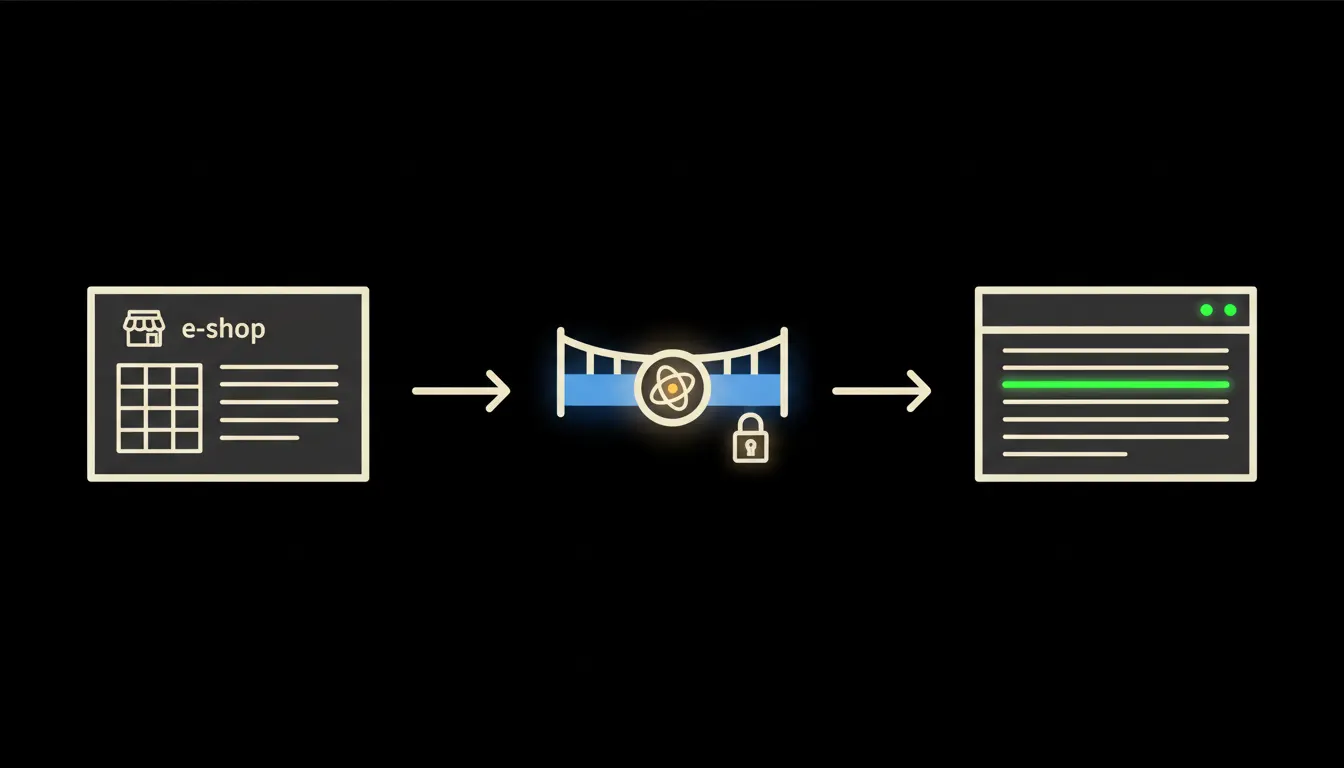
Pohoda has an XML API. Shoptet has a REST API. Both sides can communicate with the outside world, but nobody put them together. An AI stack MCP server is exactly that missing layer: a small, focused server running on your own infrastructure that reads an order from the e-shop and writes the corresponding document into Pohoda.
Claude orchestrates the whole flow. But the critical detail is this: every action carries the identity of a specific user. The MCP server does not run as an anonymous bot with access to everything. It operates under the account of the operator who triggered the action. Claude sees only what that person would see themselves.
Concretely: Shoptet and Pohoda E1
Shoptet powers over 30,000 e-shops in the Czech Republic and Slovakia. Pohoda E1 or SQL sits behind many of them in accounting. Both systems are already in place; both have APIs. We add the MCP server that joins them, and Claude then processes orders continuously without manual input.
- A new Shoptet order is read automatically as soon as it arrives.
- Claude creates the corresponding issued invoice or deposit request in Pohoda via the XML API.
- The stock movement is written immediately, keeping inventory in sync.
- The customer receives confirmation with a document number without any operator touch.
- The entire action is recorded in an audit log under the identity of the operator who initiated it.
A smaller e-shop, say a family business selling spare parts or household goods, can save an hour of pure copying every day this way. The operator shifts to work that actually needs them: complaints, non-standard orders, supplier communication. [Illustrative estimate for an e-shop with 25-40 orders per day.]
What the connection will not do, and why that is good
Claude does not handle complaints. It does not decide on discounts. It does not approve order cancellations above a set threshold. These actions stay with a person because they require judgement, contextual knowledge or accountability that cannot be delegated to automation.
This boundary is not a limitation. It is exactly what makes the connection trustworthy. The business knows what Claude does and what it does not. Closing the books, approving an exception, deciding on a credit note amount: these are moments when a person must be present. Routine order copying is not one of those moments.
What it would take
The MCP server runs on your infrastructure, not ours. Data from Pohoda and Shoptet never leaves your environment and never sits in a third-party cache. The setup does not require AI stack to have access to your accounting: the server only holds the access your operator already has.
The setup does not take a year. Pohoda XML API is documented, Shoptet has a REST API with clear authentication. We configure the specifics for your e-shop and your version of Pohoda together. If you want to know what this would mean for your specific setup, write to us. A short call is enough to scope it.
The model is not the bottleneck. The gap is.
Claude can work with an order, an invoice and a stock record. The problem was never the model. It was that there was no reliable, secure bridge between the e-shop and Pohoda. The MCP server builds that bridge: no data store of its own, no shared credentials, no broad access.
If your e-shop runs on Shoptet or WooCommerce and you keep accounts in Pohoda, write to us. We will describe what the connection would look like for your specific setup, and you decide whether it makes sense.