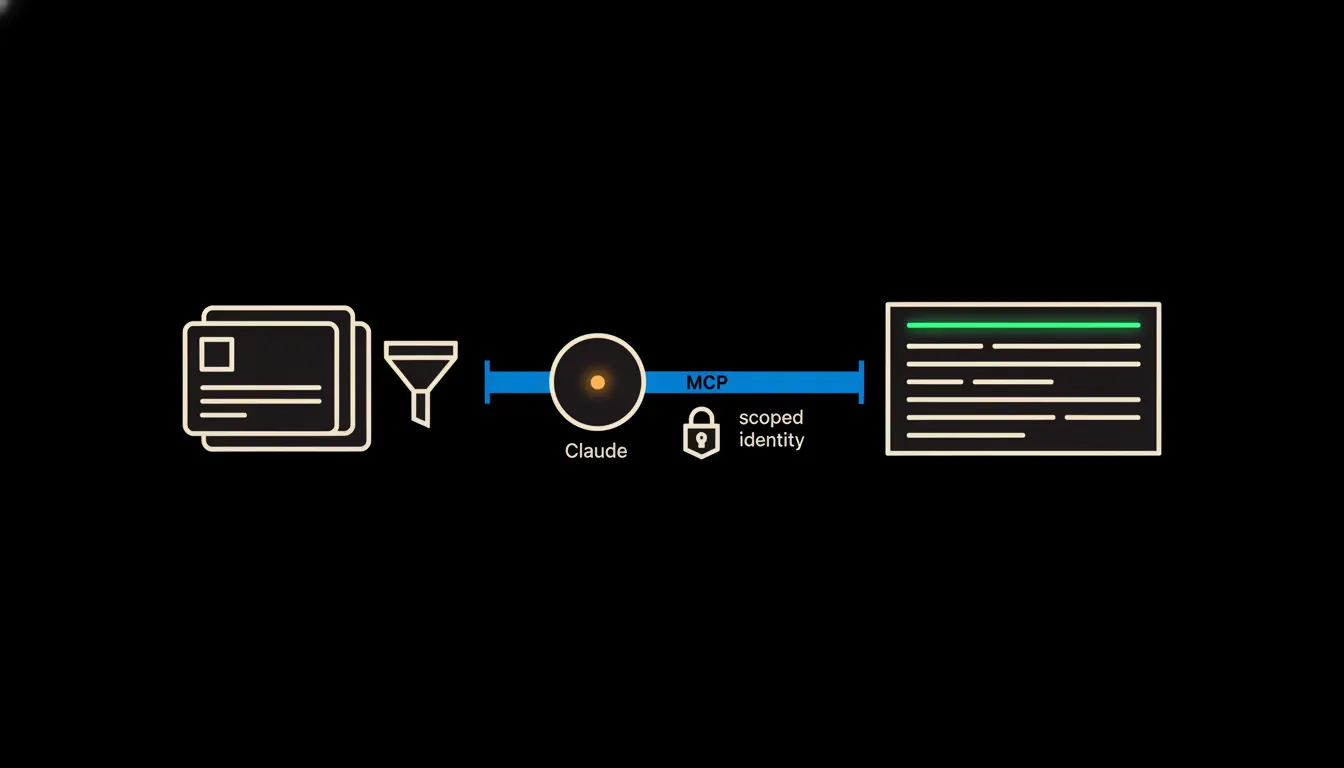
Looking for an MCP server for Raynet? It is a small bridge that lets Claude ask Raynet about companies, deals and activities while signed in as a specific salesperson. The answer contains only what that person can already see in Raynet today. No copy of the database, no export to a spreadsheet.
The work nobody wants
Monday morning, sales meeting. Before it starts, everyone is clicking through Raynet: which deals have stalled, where the next step is missing, who got an offer last week and went quiet. The sales lead builds an overview out of filters and an Excel export, because the pipeline on screen never quite answers the question they actually have.
Before a client meeting, the same thing on a smaller scale. Open the company, read the activity history, find the latest offer, go through the notes left by whoever handled the account before. Ten minutes per meeting just to know where things stand. The data is all there. Someone just has to walk over to it by hand, every time.
It's all in Raynet. I just have to find it again every single time.
— A Monday sales meeting, abridged
What an MCP server for Raynet actually means
MCP, the Model Context Protocol, is an open standard Anthropic published in late 2024. It describes how Claude connects safely to another system: which tools it may call and what the system sends back. Think of a standard wall socket. Any appliance built to the standard plugs straight in.
An MCP server for Raynet is a small program that talks to Raynet through its public API and offers Claude a handful of clearly named tools: find a company, list open deals, show this week's activities, summarise the latest offer. What matters is who it calls as. The Raynet API works with a specific user's login, so the server never asks as an administrator. It asks as the salesperson sitting in front of Claude. Nothing is copied or indexed; the server reads the records at the moment of the question.
Concretely: the Raynet you already run
Raynet stays where it is. Your team keeps logging meetings, running deals and sending offers in it. The bridge sits alongside. For a team of ten salespeople, that could mean (purely as an illustration) an hour or two per person each week that currently goes into searching and assembling overviews.
- Before a meeting: the company, recent activities, open deals and the latest offer, summarised on one screen.
- The Monday overview: deals with no next step scheduled, and deals that have sat still for more than a month.
- After a call: a draft activity and next step that the salesperson checks and saves to Raynet with one confirmation.
- For the sales lead: a pipeline summary by stage and by salesperson, limited to what they are allowed to see in Raynet.
Picture a small Brno company selling industrial cooling: three salespeople and one assistant (an illustrative example). Before a site visit, a salesperson asks Claude, 'What has happened with this customer over the last six months?' and gets an answer built from the records they can see in Raynet. The assistant's Raynet role covers only contacts and activities, so the same question gets the same picture, minus the offer prices. Nobody set anything up twice.
What an MCP server for Raynet won't do, and why that's good
It won't decide who gets a discount, and it won't move a deal to the next stage on its own. It proposes entries for Raynet; a person saves them. It won't route around permissions however cleverly the request is phrased, because the server simply has no access it could misuse.
That limit is the reason to trust it. Management doesn't have to wonder whether the AI knows everything. It knows exactly what the person asking knows, and every answer traces back to the Raynet records it came from.
What it would take
Not a year-long project. We start with the one or two questions your sales team asks most often and build an MCP server with a few tools around them. It runs on your own cloud, signs in with each user's identity and keeps an audit trail. Once it proves itself, recurring routines such as meeting prep go into the skills library, and the whole team can use them the next morning.
What's left
Claude can turn a long account history into one readable paragraph. That stopped being the hard part a while ago. The hard part is that without a bridge it has no access to your sales data, and with a careless one it sees more than it should. The model is not the bottleneck. The gap between Claude and the data already sitting in Raynet is.
We close that gap. If you would like to see what an MCP server for your Raynet could look like, write to us. A short call is enough to find the two questions that would save your sales team the most time.