Monday at ten, there is a meeting. Six people show up. Each says three sentences about what they did last week and where it got stuck. Forty minutes later they leave and go back to the work that was waiting for them. This repeats every week — not because anyone likes it, but because without it the manager would have no idea where things stand.
The work nobody wants
A status meeting is not a meeting. It is a ritual for collecting information that pretends to be a meeting. The project manager asks, the sales manager answers, someone takes notes that nobody reads. Meanwhile, in the task board, in the CRM, and in email, there is exactly the data that would answer every one of those questions — it just never got collected.
The problem is not the people or the tools. The problem is the gap: data sits in one place, the overview is needed in another, and until now the only way to bridge that gap was a live person in a room.
I came to the meeting to hear things that are already written in our systems. I came in late to work to listen to them read out loud.
— Monday morning, abridged
What it actually means: Claude + MCP + your data
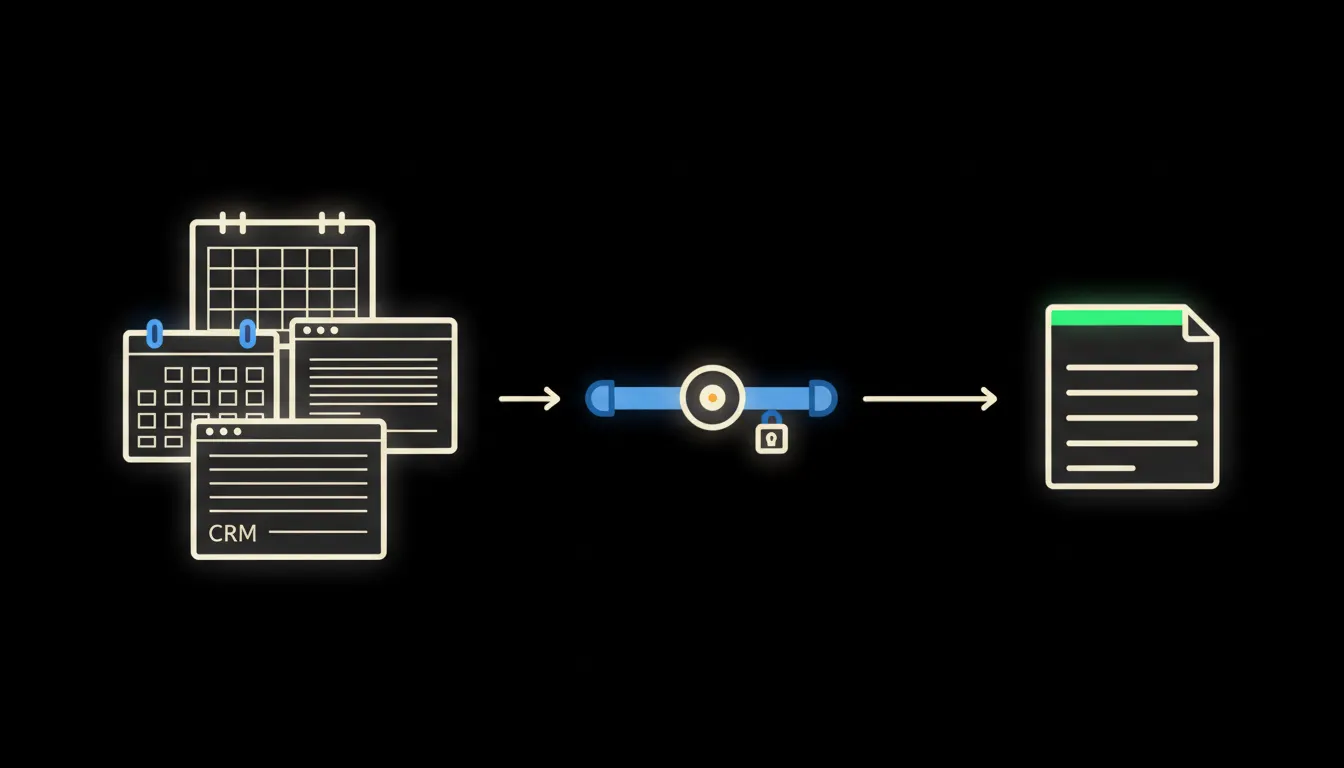
AI stack builds a small MCP server — a bridge that connects to the tools your company already uses. It reads project status from Trello or Asana, open deals from your CRM, invoices from your accounting system, the last five threads from email or Slack. Then it assembles a digest: what is done, what is stuck, what is waiting for your decision.
Every MCP server carries your identity. Claude sees exactly what you would see — no more, no less. No copy of your data on a third-party server, no vendor cache. The digest runs on your infrastructure and disappears with the session.
Concretely: a CRM, a task board, and an accounting system
Say the sales team uses a CRM, projects are tracked in Trello, and invoices go through accounting software. Three systems, three logins, three different data formats. Claude connects to all three via MCP server — under your identity — and returns a digest in under two minutes: five deals that have not moved in a week, three tasks past their deadline, two invoices outstanding for more than thirty days. An illustrative estimate: for a team of ten, this maps to roughly two hours of meetings per week that no longer need to happen.
- Reads the state of all active tasks and flags any that have not changed in seven days.
- Filters CRM deals where the last activity was more than ten days ago.
- Checks overdue invoices and adds them to the digest with context — who, how much, how long outstanding.
- Assembles one page in the format: done / stuck / waiting for you — and delivers it to the manager before the working day begins.
For a Czech company of twenty people, this means the Monday meeting can shrink from forty minutes to fifteen — or not happen at all. Instead of collecting information, you talk about decisions. That is a different kind of meeting.
What Claude will not do — and why that is good
Claude will not decide that a project is behind and resources need to shift. It will not escalate a conflict between two departments. It will not name a priority for you. The digest it assembles is a briefing — accurate, current, free of noise. What you do with it is yours.
This is not a limitation to be overcome later. It is the property that makes the system trustworthy. A manager who knows where things stand makes better decisions. Claude makes sure you know. The decision stays where it belongs.
What it would take
One MCP server for each system you want to include. Access configuration — who sees what — done once, upfront. The digest then runs on demand or automatically every Monday morning. No year-long project, no data migration, no new app for employees to learn. Your tools stay. A bridge is added.
What is left
The model is not the bottleneck. Claude can read data from dozens of systems and assemble an overview that would take a person half a day. The bottleneck is the gap between Claude and your systems — that gap is called integration, access rights, data formats. That is exactly what we build.
If you are curious what this would look like for your company and your tools, write to us. A short call — no commitment — and you will know what the first MCP server would solve and what it would involve.