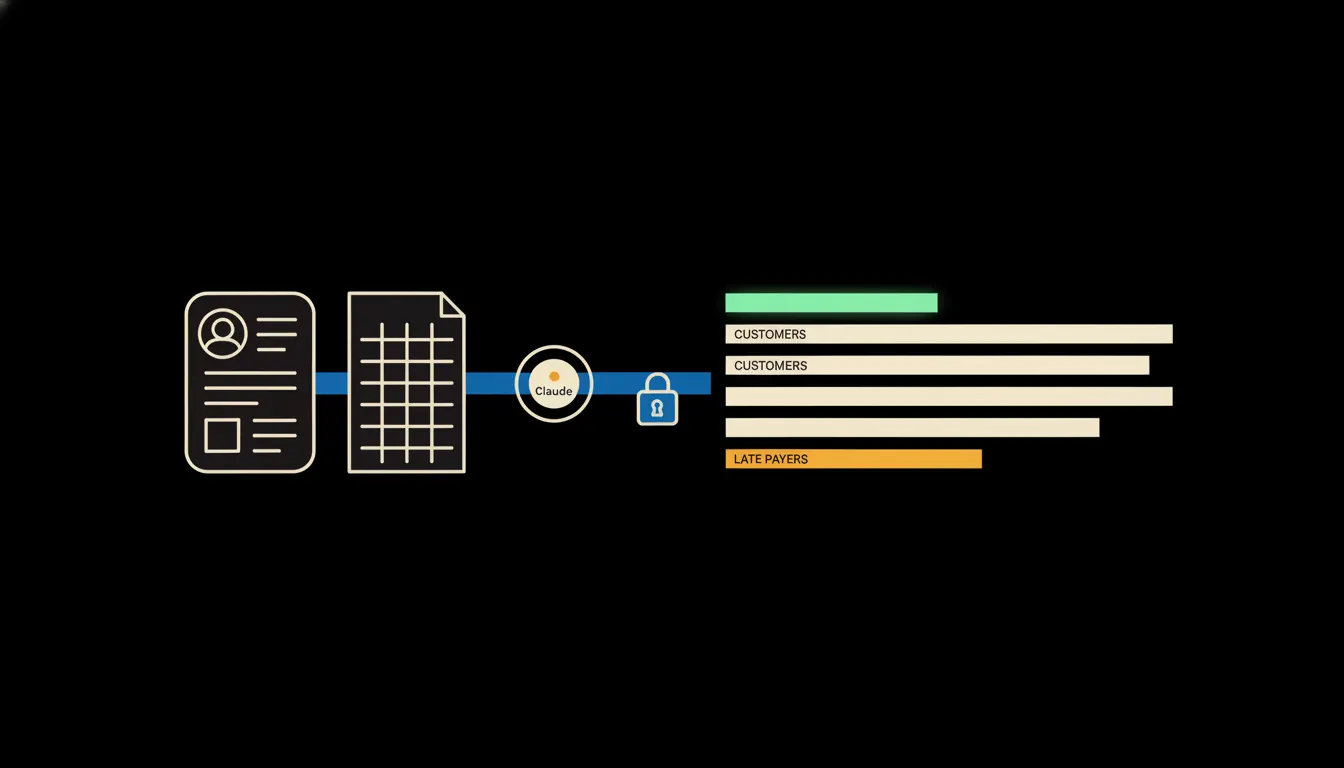
You probably have a good idea who pays you late. The trouble is where that knowledge lives: customers and terms in the CRM, invoices and payments in Pohoda. A report on customer payment behavior can be built from that data in a single question, as long as Claude can see both. Here is what that looks like and what it takes.
The work nobody wants
At month end someone in finance opens the list of unpaid invoices in Pohoda, exports it to a spreadsheet and starts matching it against the CRM by hand. Which salesperson owns the account. What the agreed terms are. Whether the delay is covered by an installment plan. Then comes the meeting, and the owner asks: is this customer late for the first time, or always?
Nobody has a quick answer, because payment history lives in accounting and relationship history lives in the CRM. The spreadsheet is assembled by hand, goes stale within a week and gets rebuilt the next month. Meanwhile the company keeps shipping on 30-day terms to a customer whose last five invoices were paid two months late.
"He always pays, just late." A sentence every finance director has heard, and nobody has ever measured.
— A cash flow meeting, abridged
What connecting the CRM and accounting actually means
Connecting does not mean another system or a data warehouse. It means two small MCP servers: one into the CRM, one into Pohoda. Through them Claude asks the same question a person would ask with both windows open side by side: which invoices, due when, paid when, for which customer and on what terms.
Every query runs under the identity of whoever is asking. The data stays in the source systems. Claude does not copy it or index it anywhere. The report is built from current figures at the moment you need it, instead of from last Monday's export.
Concretely: Pohoda and your CRM
Pohoda stays, the CRM stays, nobody learns new software. The only addition is the bridge. For a company with a few hundred customers and several thousand invoices a year (an illustrative scale), that means trading the monthly spreadsheet for an answer to a question like: which customers paid on average more than 15 days past due over the last six months, and how much do they still owe us?
- Matches invoices and payments from Pohoda to customers and salespeople in the CRM.
- Works out each customer's average delay, how it is trending and the open balance.
- Flags customers whose delays have been getting longer in recent months.
- Suggests a step: shorter terms, a deposit, or delivery only after payment.
- For overdue invoices, notes that Czech law allows statutory late interest and a flat fee of 1,200 CZK for pursuing the debt.
An illustrative example: a building materials wholesaler in Brno, ten people, one accountant. On Monday morning the owner asks which customers should not get goods on credit this week. Claude returns five names, each with an average delay, an open balance and a CRM note showing that two of them promised the salesperson payment by Friday. The decision takes a few minutes instead of an afternoon.
What a payment behavior report will not do, and why that is good
Claude will not stop deliveries, hand a debt over for collection or change a customer's contract terms. It shows the figures and suggests a step. Whether it is worth keeping a customer who pays late but orders a lot is a commercial call. That belongs to the owner or the salesperson who knows the margin and the history of the relationship.
That boundary is exactly why the report can be trusted. The bridge reads data, writes nothing to the books without confirmation, and every query carries a name in the audit trail. When the finance director asks where a number came from, the answer is specific invoices in Pohoda, not a guess.
What it would take
It starts with a short conversation: which CRM you use, which version of Pohoda, who should see what. We then build two MCP servers and deploy them on your infrastructure, under your accounts and your permissions. No year-long project, no data migration. The monthly report is saved as a shared skill, so anyone with the right access can run it in the morning.
What is left
The model is not the bottleneck. Claude has no trouble calculating average delays and ranking customers by risk. What it lacks is access to the data you already keep in two systems. That gap is what we close.
If you want to see what a payment behavior report would look like on top of your own CRM and Pohoda, write to us. A short call is enough for us to tell you what it would take in your case.