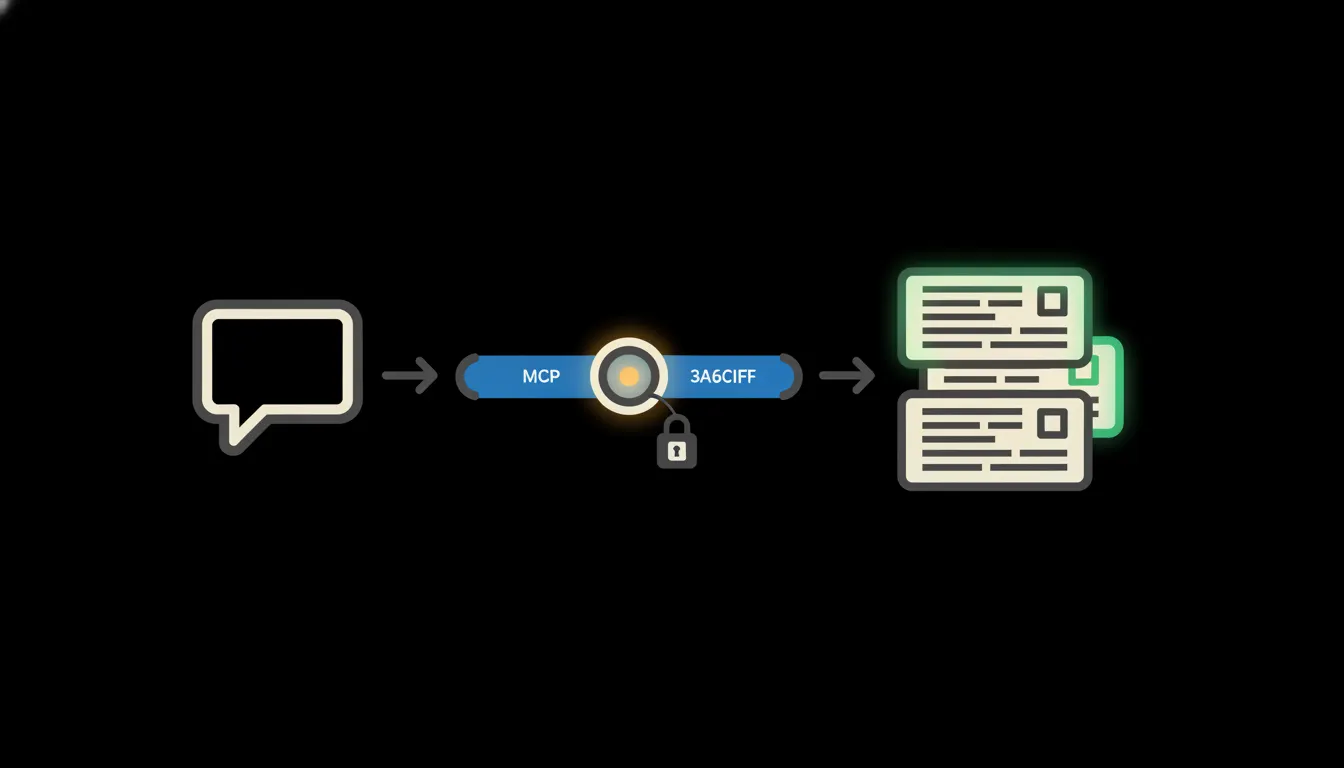
An AI assistant is a chat that knows your company. A plain chat answers from what it learned from public text. An assistant answers from your invoices, orders, contracts and mail, because it is connected to them. That is the whole difference, and it is bigger than it looks.
The question you answer every day
A customer calls. They want to know when the order ships, and by the way, do they get the same discount as last year. The answer exists inside the company. It is just not in one place. The order status is in the e-shop. Anything overdue shows in accounting. Last year"s quote sits on the shared drive, in one of four folders. And whatever was last discussed with that customer is somewhere in mail.
So the person on the phone opens five windows. Sometimes it takes two minutes, sometimes twenty, because somebody renamed the quote. Nobody logs it as work, and it still chops the morning into pieces. This is not a failure of people or tools. It is the distance between the question and the data.
The answer existed. It was just scattered across five windows.
— An ordinary Tuesday at a small company
What makes an assistant different
A chat in a browser has general knowledge. Ask it how to word a payment reminder, what a clause in a contract means, or how to structure a quote, and the answer is useful. Ask it how much that particular customer owes you and it goes quiet. It has nowhere to look. It has never seen your accounting.
An assistant is the same model, Claude, plus a connection. That connection is a small program called an MCP server. It is a bridge between Claude and one system: one bridge into accounting, another into the e-shop, another to the shared drive. The bridge copies nothing and uploads nothing. When you ask, it looks into the system at that moment and comes back with the answer. And it goes there under your name, with your permissions.
Concretely: accounting, the e-shop and the shared drive
Take an ordinary Czech company of under fifty people. Accounting in Pohoda, the shop on Shoptet, documents on a shared drive, mail in Microsoft 365. None of it is retired, nothing moves, nobody learns a new interface. A bridge is simply added. Roughly days of work per system, not a year-long programme, because each bridge does one thing.
- Finds the customer in the e-shop and pulls the status of the latest order.
- Checks accounting for anything overdue, and how much.
- Digs out last year"s quote on the drive and the discount that was in it.
- Recalls from mail what was last discussed with that customer.
- Writes it up as a paragraph you read before you send it.
Picture a part-time bookkeeper who also handles customer support. Instead of five windows, she types one sentence: when does Mrs Novakova"s order ship and does she have anything overdue. Seconds later she has a paragraph, each figure labelled with the system it came from, and she decides what to reply. The example is illustrative, but the scene repeats daily in small companies.
What an assistant will not do, and why that is good
It will not approve a discount. It will not send the mail for you. It will not post an invoice. It will not change a price in the shop. It prepares the material, drafts the reply, shows where every number came from, and stops. The last click belongs to a person.
That boundary is a design choice, not a shortcoming. If the assistant decided on its own, you would have to check every step it took, and checking would eat the hour you saved. This way you check the result. And because everything goes through one bridge carrying your identity, it stays visible who asked what and where each answer came from.
What it would take
You start with one system and the question your people repeat most often. We build the bridge, wire it to your logins and roles, and let a few people ask for a week. It runs on your infrastructure, in your cloud, under your accounts. No extra pile of data at someone else"s vendor. When the first bridge holds, the second one follows.
What is left
The model stopped being the bottleneck a while ago. Claude can read a contract, assemble a summary and write a decent reply to a customer. The bottleneck is the distance between the model and the data your company has had for years. That distance is what we close.
Write to us. On a short call we will name the one question your people answer most often, and tell you straight away what the first bridge would involve. No deck, no year-long project.